Missing one sign can change everything. Picture this: you’re cruising down a familiar road, then you spot a sudden turn too late. One small change in speed and position, and it turns into a near-miss.
Road signs are the language of the road. In the US, they follow rules in the MUTCD (Manual on Uniform Traffic Control Devices). The latest version is the 11th Edition with Revision 1, effective March 5, 2026. When you understand road signs easily, you reduce crashes and also avoid tickets that come from misreading rules.
So how do you get there fast? Start with the main sign types, then learn how shape and color give you instant clues. After that, you’ll recognize common signs by memory, and you’ll pick up a few beginner tricks that make recognition automatic.
Break Down the Four Main Types of Road Signs
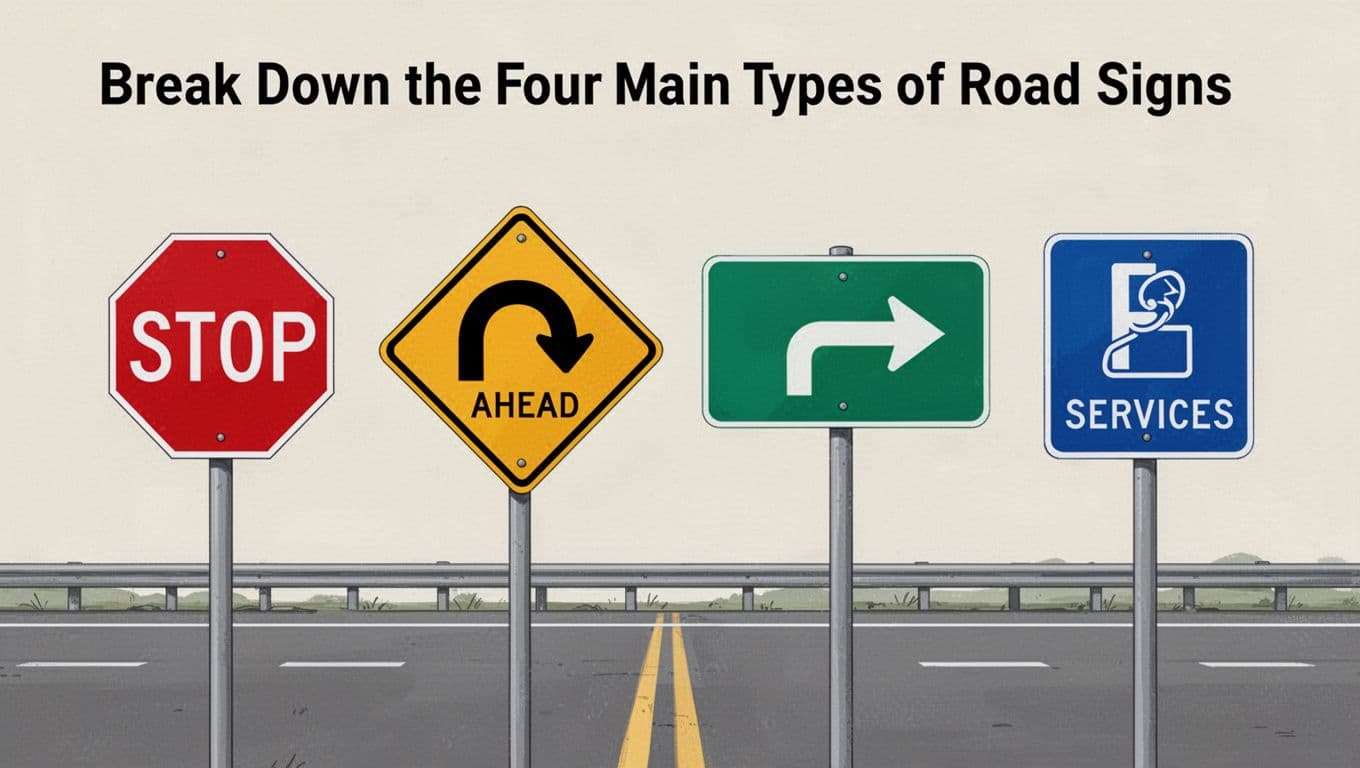
Think of road signs like different pages in the same book. They all point you forward, but they each do a different job. In MUTCD terms, the big categories are regulatory signs, warning signs, guide signs, and informational signs. Some signs combine jobs too, but the purpose stays clear.
Here’s a simple way to remember the role of each type:
- Regulatory signs: Tell you the law. If it says “must” or “no,” you have to follow it.
- Warning signs: Tell you to slow down or get ready. They show a danger ahead.
- Guide signs: Help you find your route. They support turns, exits, and direction choices.
- Informational signs: Add helpful details. They can include services, distances, and rules that aren’t “must do” laws.
If you want to go deeper, the FHWA keeps the MUTCD updates in one place. See MUTCD 11th Edition, Revision 1 (December 2025) for the latest changes and resources.
What changed for cyclists and pedestrians recently?
As of 2025 and 2026, updates in the MUTCD place a stronger focus on vulnerable road users. That includes cyclists and pedestrians. The changes build safer traffic control guidance, especially where drivers need to react early and clearly.
Also, states work under national standards. The Federal Register covers the national standards for traffic control devices tied to MUTCD rules. You can read the notice at Federal Register: National Standards for Traffic Control Devices.
That matters for you because the same sign shapes and meanings aim to stay consistent across the country.
Spot Road Signs Fast Using Shape and Color Clues
When you’re driving, you don’t have time for long reading. So your brain uses a “quick scan” method: shape first, color second, words third.
This works because MUTCD design patterns create fast recognition. Once you learn the basics, signs feel less like random symbols and more like a system.
Here’s the quick cheat sheet.
| Sign shape | Usual meaning | Driver takeaway |
|---|---|---|
| Octagon | Stop (regulatory) | Come to a full stop |
| Triangle | Yield (regulatory) | Slow down, prepare to stop |
| Diamond | Warning (warning) | Slow, watch for hazards |
| Rectangle | Guide/Info (often) | Follow directions or read details |
| Circle | Often special rule | Treat it as a specific instruction |
Keep in mind, you’ll see exceptions. Still, this pattern gives you a fast head start.
Shapes That Shout Their Message Before You Read Words
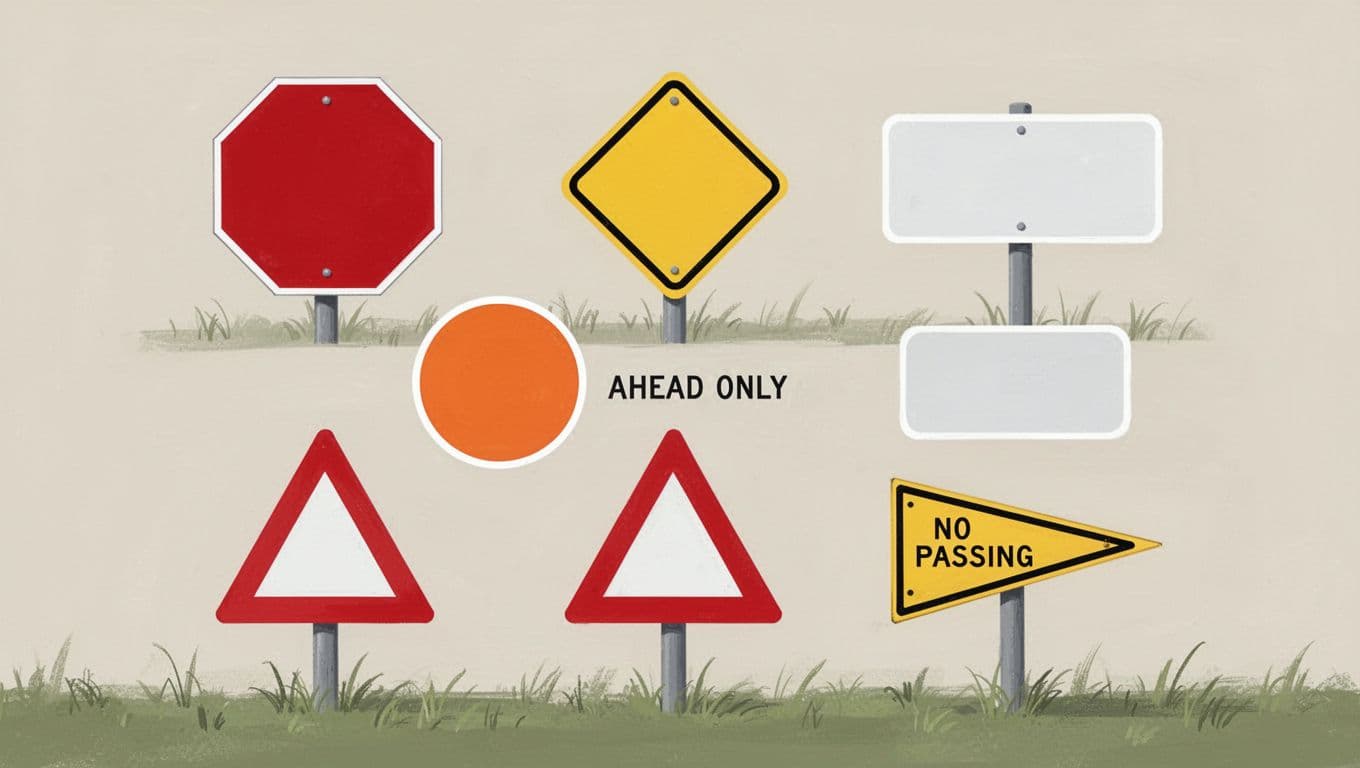
Some signs look like they’re “shouting” because the shape is bold and easy to spot. For example:
- Octagon usually signals “stop” without you reading anything.
- Triangle usually signals “yield,” meaning you must give right-of-way.
- Diamond usually signals a warning, like curves, intersections, or school areas.
- Pennant (long triangle end) usually signals “no passing.”
- Circle signs often mark specific restrictions ahead, not a general warning.
Also, sign sizes use visibility rules so the message stands out at driving distances. In plain terms, the bigger the sign, the more time you get to notice it.
If you want the bigger picture of how the MUTCD organizes these standards, check Manual on Uniform Traffic Control Devices (MUTCD) – FHWA. It’s the main hub for the guidance.
Colors That Trigger Your Brain Instantly
Color works like a traffic light for your eyes. Even before you read the words, the color gives your brain a “mode.”
Common color meanings include:
- Red: Commands and prohibitions (like stop or no entry).
- Yellow: Alerts and warnings (something needs your attention).
- Green: Guidance and direction (like route choices).
- Blue: Service and info (like parking or rest areas).
- Orange: Construction and temporary hazards (work zones ahead).
- White with black: Regulatory rules and lane guidance.
A big reason this helps is speed. You can react sooner, and that reduces sudden braking and late turns.
Must-Know Everyday Road Signs with Picture-Perfect Meanings
Some signs matter more because you see them constantly. If you can recognize these, you’ll feel calmer on new roads too.
Here are eight high-value signs to memorize. Picture each one before you drive, and your recall improves fast.
- Stop: Come to a full stop at the line or intersection. Then check for cross traffic and pedestrians.
- Yield: Slow down and give the right-of-way to vehicles already there, or pedestrians in the way.
- Speed limit: Drive at or below the posted number. Adjust for weather, curves, and traffic.
- One way: Only travel in the direction shown. Watch for one-way arrows on street signs too.
- No entry: You’re not allowed to enter that lane, road, or ramp. Treat it as a hard stop for your plans.
- School crossing: Expect kids near the roadway. Reduce speed and watch for sudden movement.
- Curve ahead: The road bends soon. Slow down early, then steer smoothly.
- No U-turn: You can’t make that turn where the sign is posted. If you try anyway, you risk a ticket.
Control Signs Like Stop and Yield
Control signs tell you what to do now. Their job is simple: keep traffic moving safely and predictably.
Stop means a full halt, no rolling. You stop before the line, crosswalk, or intersection point. After that, you check left, right, and left again if needed. Then you go when it’s safe.
Yield means you approach slower and be ready to stop. Drivers often make the same mistake here. They slow down, but they don’t fully prepare for the possibility of stopping.
Common mistakes to watch for:
- Treating yield like stop
- Entering too fast because “you looked”
- Forgetting pedestrians at crosswalks
When you obey control signs, other drivers can predict your next move. That reduces confusion.
Speed Safety and School Zone Essentials
Speed signs connect to safety fast. A posted limit doesn’t mean “ignore the road.” It sets a baseline. You still need to slow for rain, glare, and tight curves.
In school areas, the sign message gets stronger. You’ll often see:
- Speed limit (reduced) during school hours
- School crossing ahead
- Sometimes flashing beacons or special school zone wording
If you see a school crossing sign, think “kids can appear fast.” That’s the main idea. Kids may step out from parked cars, buses, or between adults. So you brake early and keep your eyes moving.
Also, watch for “no U-turn” signs near schools. These signs help limit conflict points when parents and buses pull in and out.
Simple Tricks to Master Road Signs as a New Driver
Road signs don’t get easier because you try harder. They get easier because you build quick habits.
First, start with recognition, not memorization. Learn the main purpose of each sign type. Then tie that purpose to shape and color.
Next, practice in real life. On every drive, pick one category at a time. Today, focus on warnings. Tomorrow, focus on regulatory signs. Soon you’ll recognize patterns without thinking.
Here are beginner-friendly ways to build confidence:
- Group signs by job (rule, warning, directions, info), not by randomness
- Use short “spot checks” every few blocks, then confirm what the sign means
- Quiz yourself when you stop at lights, glance at nearby signs, then recall the meaning
- Practice at different times of day (morning glare changes how colors look)
Also, don’t ignore updated MUTCD designs where they show up. The 11th Edition release started rolling into the real world in phases, and some newer sign designs aim to improve clarity for cyclists and pedestrians. Final sign designs were released in 2026, so you may notice more consistent visuals as states adopt them.
If you want extra help with common meanings, Road Signs & Traffic Signs in the US: The Definitive Guide can be a useful study companion.
Most importantly, don’t treat signs like test questions only. Treat them like instructions from someone standing beside the road. That person wants you safe.
Conclusion
Road signs are how the road talks back to you. When you learn the four main sign types, you stop guessing and start understanding fast.
Then let shape and color do the heavy lifting. Once you connect octagons to stop and diamonds to warnings, reading signs becomes almost automatic.
Finally, memorize the everyday signs you see most. If you combine that with calm practice, you’ll handle unfamiliar roads with less stress and better choices.
If that near-miss feeling from the start shows up again, slow down and scan signs earlier. Knowing what they mean protects you, the people around you, and everyone following the same MUTCD rules.