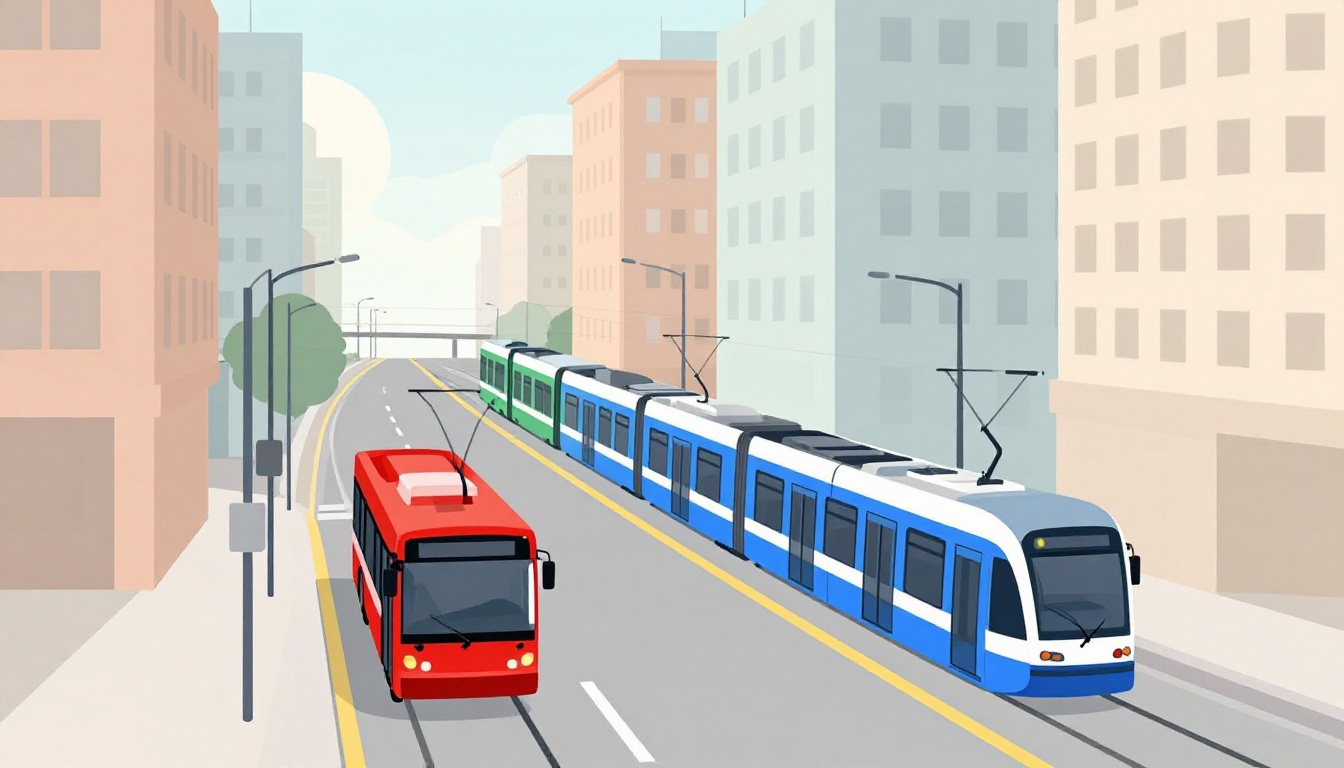
Have you ever stood at a busy stop and wondered which ride will get you home fastest? You might see a bus pulling in, a tram gliding past, and trains in the distance. All three move people across cities. Still, their design choices create big differences in speed, comfort, and where they work best.
That difference between buses, trains and trams can feel confusing at first. But it boils down to one idea: what they run on, and how much they’re stuck in traffic. Once you understand that, you can judge any transit plan with clearer eyes.
Let’s break it down from the basics, then compare how each mode operates, what it costs to build, and how well they handle real daily trips in 2026.
What Sets Buses, Trains, and Trams Apart at Their Core?
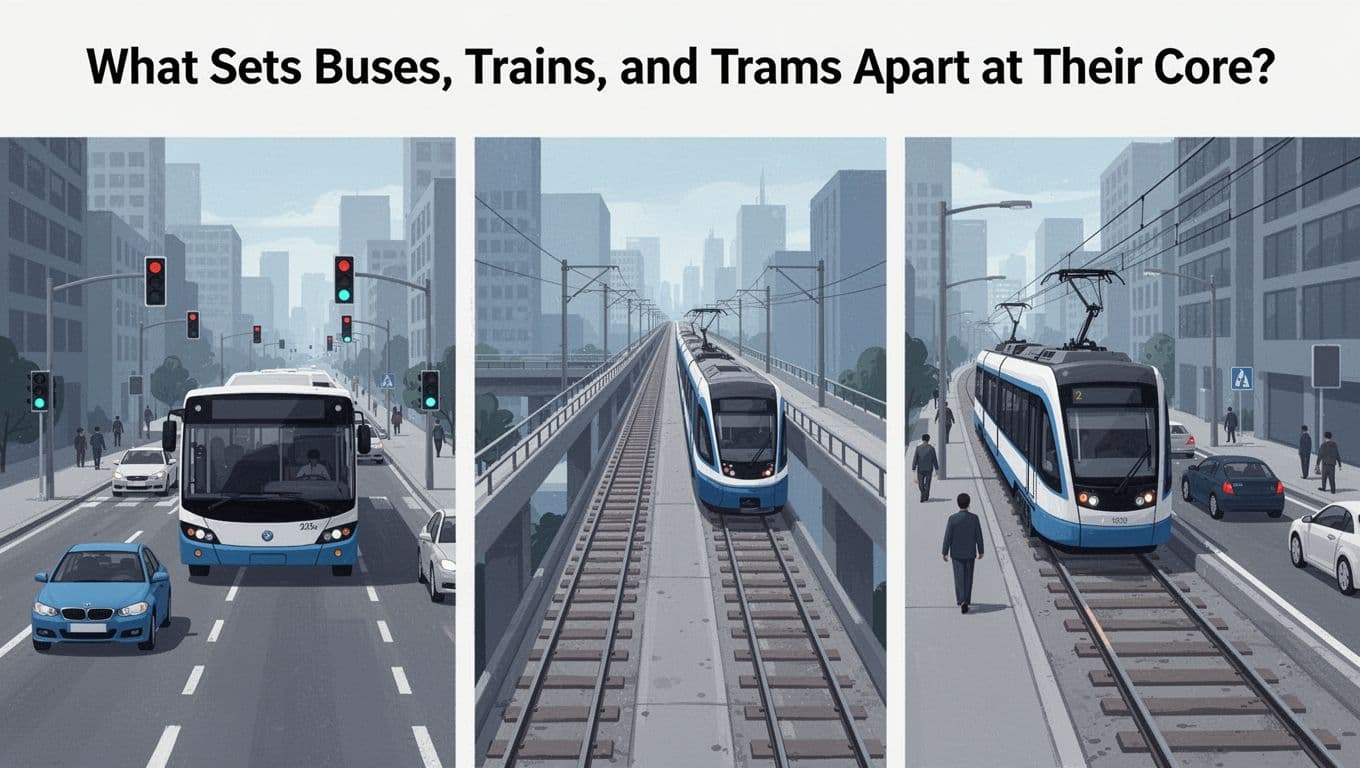
Think of transit modes as different “tools” for city travel.
- Buses ride on regular roads.
- Trains run on exclusive rail tracks, usually heavy rail or metro lines.
- Trams run on rail too, but their tracks often sit in city streets.
A bus is like a flexible SUV. It can turn routes to match demand. A train is more like a speedy bullet on rails. Once it’s on its track, it can move fast and carry a lot. A tram feels like a nimble street dancer. It blends into neighborhoods, especially where tracks share space with cars and pedestrians.
To make the bus versus rail debate less messy, Human Transit lays out how people often argue past each other, because the real differences come from service design, not only the vehicle. If you want a clean starting point, see Basics: Sorting Out Rail-Bus Differences.
The key infrastructure idea (the “why” behind the outcome)
Your trip speed and comfort depend mostly on these factors:
- Where the vehicle travels (streets, dedicated lanes, or exclusive tracks)
- What it shares space with (traffic, pedestrians, or none)
- How often it can stop and start (station spacing and signal control)
Rail tech gets technical fast, but you can still grasp the main separation. For a simple, practical breakdown of metro, light rail, and trams, check Metro, Light Rail, and Trams: The Technical Differences Explained.
Quick reality check
People often say, “Trains are better than buses.” That can be true for capacity and speed. However, buses can win on route coverage and cost, especially with modern service like bus rapid transit (BRT).
Now let’s zoom in by mode.
Buses: Flexible Road Travelers
Buses run on normal roads, so they follow the same rules as cars most of the time. That means you’ll see them stop at intersections, yield at turns, and deal with traffic light timing.
Because buses use existing roads, they can spread fast. A city can add a route in months, not years. Also, buses reach places that rail usually won’t, like smaller streets and lower-density suburbs.
That said, buses can feel slow during rush hour. A stuck bus is still stuck, because it’s sharing road space with traffic.
So cities started improving buses instead of waiting for expensive rail builds. The standout upgrade is BRT, which uses tools like dedicated lanes, queue-jump signals, and faster boarding. In other words, BRT tries to give buses “train-like reliability,” while keeping their route flexibility.
Trains: Powerhouses on Exclusive Tracks
Trains (especially metros and heavy rail) typically run on exclusive tracks. That means they do not compete with cars at street intersections the way buses and many trams do.
Because the track is controlled, trains can maintain steadier speeds. They also carry far more people per vehicle. This is why metro systems in dense cities can move huge crowds every day.
Trains also handle frequent service well, especially when stations are spaced for commuters. Add consistent signaling and platform design, and trips get smoother.
The big tradeoff is flexibility. Trains need tracks, power, and stations. Once built, rerouting is hard and slow. If a neighborhood shifts, rail may lag behind the new travel pattern.
Trams: Rail Meets City Streets
Trams also use rail, but they usually operate closer to street life. Their tracks might run in the road median, along a lane, or across shared crossings.
Because trams interact with the urban street, they can be slower than a metro. However, they can still beat buses when they get priority through signals and don’t get blocked as often.
Trams also tend to fit neighborhood-scale planning. They pair well with walkable areas, because stations can be placed where people already live and shop. You often see tram corridors with frequent stops and good local access.
A tram is a good “middle” option. It offers more predictable movement than a standard bus route, while usually costing less than a subway.
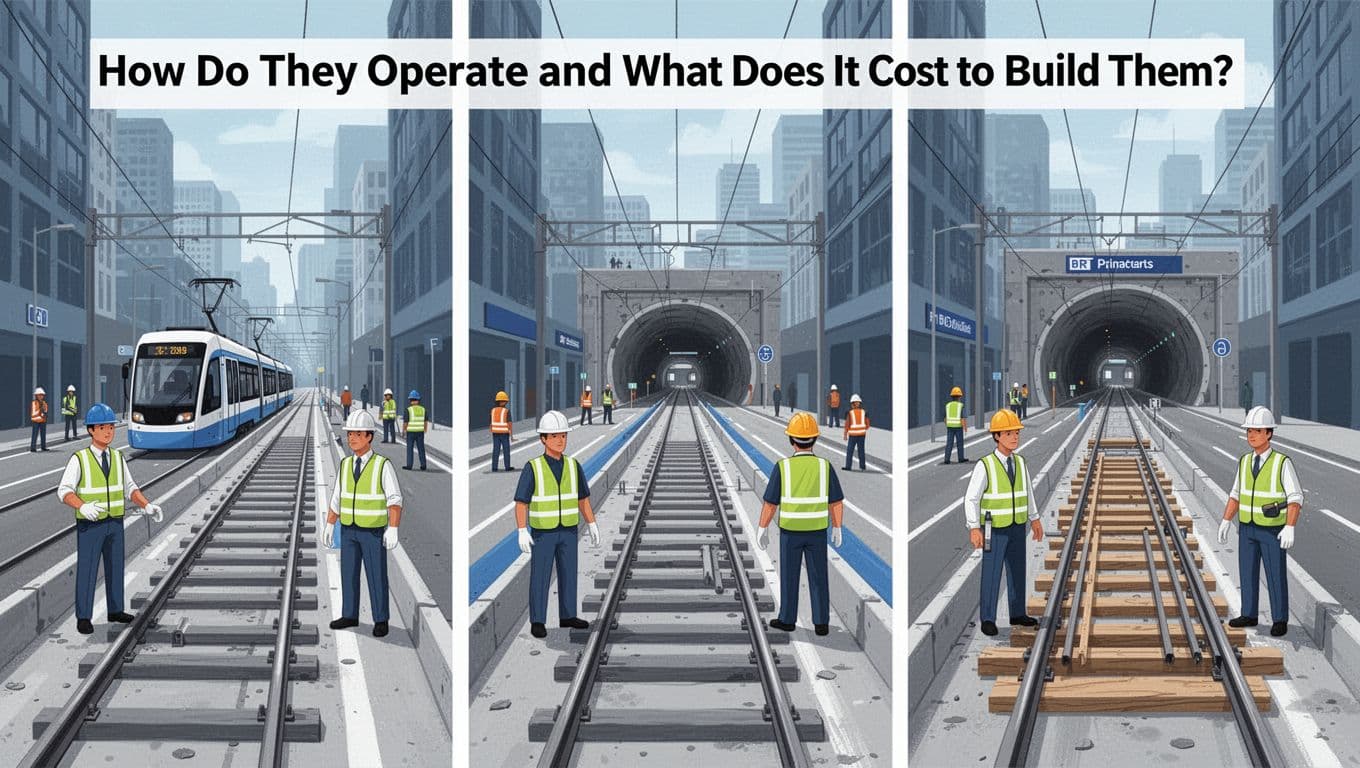
How Do They Operate and What Does It Cost to Build Them?
Let’s connect the basics to the real world. How often can you ride? How reliable is it? And how painful is the build?
In most cities, buses and trams live in the same streets. Trains usually live in their own space. That single difference drives operations and cost.
Daily Paths and Traffic Realities
Start with what happens during rush hour.
- Buses often slow down when traffic piles up.
- Trains can keep moving smoothly because they avoid street traffic.
- Trams depend on how much priority they get at intersections.
BRT aims to change bus performance. It does that by separating buses from general lanes, then using signals to reduce delays. When BRT works well, the ride feels calmer. You spend less time watching brake lights.
Meanwhile, trains can run on tight schedules because the track environment is controlled. If service is frequent, you can plan trips around a predictable timetable, even without perfect real-time updates.
Trams usually sit between the two. They may still face slower speeds in busy street sections. Yet, they can deliver a steadier rhythm than buses when lanes and crossings are managed well.
For another comparison of how different modes perform in dense service planning, take a look at Comparison: Metro Rail, Tram Services, Subway Train, and Bus Services in a Busy City.
Infrastructure Breakdown and Price Tags
Now for the part that shapes almost every transit decision: construction cost.
In the US, budgets often push cities toward BRT because it’s cheaper to build and faster to deliver. BRT also uses roads and bus lanes instead of tunnels and full rail reconstructions.
Here are recent cost ranges, based on US project examples and averages:
| Mode (typical build) | Approx cost per mile | Why it costs that much |
|---|---|---|
| BRT (bus rapid transit) | $4M to $30M | Uses roads, adds lanes or signal priority |
| Light rail (street/rail) | $100M+ | Requires tracks, power, street work |
| Subway (heavy rail tunnels) | $500M+ | Tunnels and deep construction raise prices |
In 2026, examples show the spread clearly. Baton Rouge’s BRT opened at about $4.2 million per mile. Las Vegas’ Maryland Parkway BRT came in near $30 million per mile.
In plain terms: buses usually win on price. Trams can be mid-range, depending on how much track work requires street redesign. Subways are the most expensive, especially in the US, where tunneling costs often run high.
Also remember the hidden cost: planning time. Even if a project is “only” a mile long, permitting, utility work, and traffic disruption can stretch timelines. That’s why cities keep reaching for BRT and smaller rail upgrades.
Capacity, Speed, and Flexibility: Which Wins for Your Trip?
The best mode depends on what you care about most: crowding, speed, or route fit.
Still, you can compare them with a clear logic. Trains tend to top capacity. Trams often serve urban corridors with frequent stops. Buses cover the most ground and offer the most route changes.
Passenger Power: How Many Can They Carry?
Capacity comes down to vehicle size plus how tightly the system runs.
Here’s a practical way to think about it:
- Standard buses: often about 40 to 60 seats, plus standing.
- BRT buses: often around 100 to 160 total (articulated or double-decker designs).
- Trams: commonly 100 to 300 total, depending on train length.
- Trains (metro/subway): often 800 to 1,500+ per trainset or car group, depending on design.
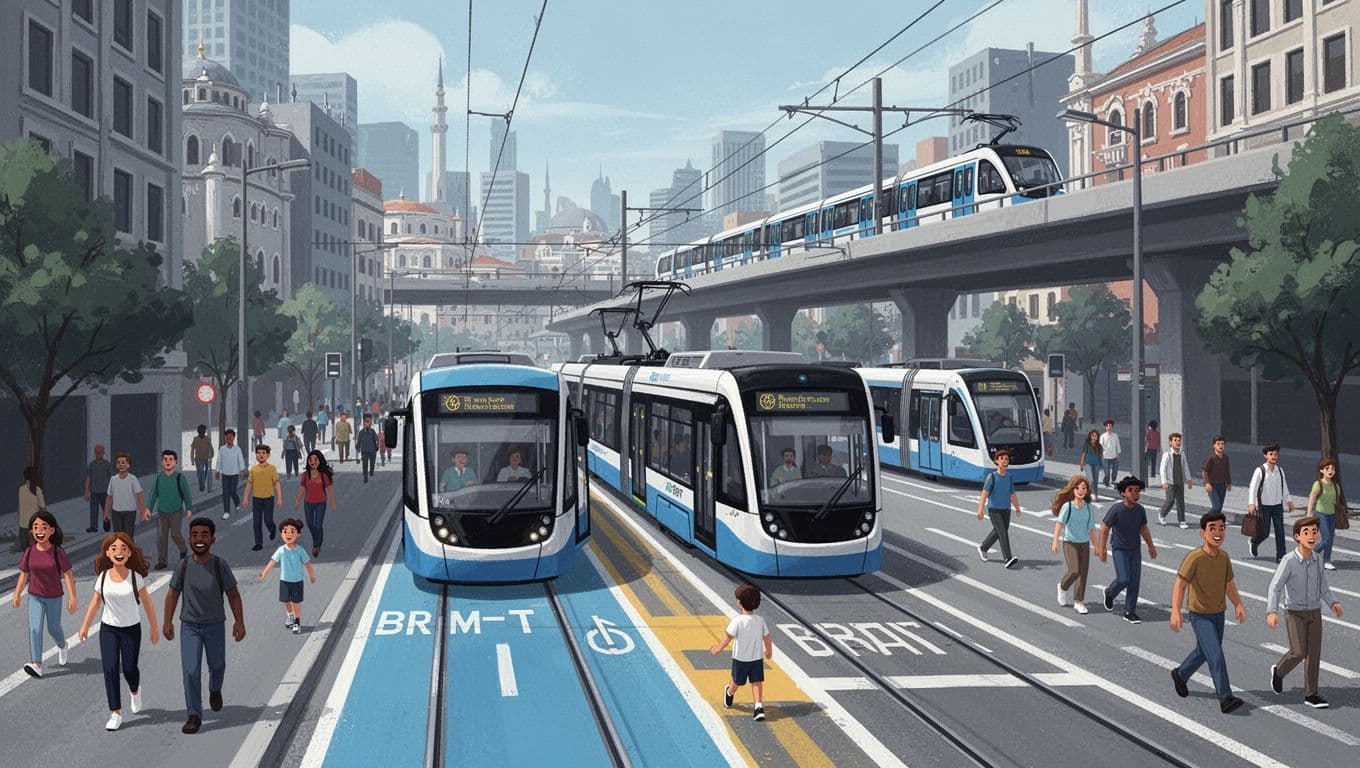
For big-ridership examples, Istanbul uses Metrobus (a BRT-style system). It carries over 1 million trips per day, mostly across a major cross-city corridor.
Cities like that show what happens when you combine strong demand with a mode that can handle volume.
Meanwhile, if you’re comparing rail types for capacity and system design, this guide on Train vs. Tram: Key Differences in Rail-Based Public Transit can help with the basics.
Race to Your Destination: Speed Breakdown
Speed depends on track separation and how often you stop.
In general:
- Trains are the fastest in the real world, especially metro systems and high-speed rail abroad. In Europe, high-speed lines can reach almost 200 mph. In the US, conventional trains usually run under 80 mph, with the Northeast Corridor reaching about 150 mph in spots.
- Trams typically run around 20 to 50 mph in city conditions.
- Buses often run around 30 to 60 mph when traffic allows, but congestion can slow them down quickly.
Buses can look slow on a map. Yet BRT can narrow the gap by cutting dwell time and reducing delays at intersections.
To keep it simple, here’s a quick scan:
| Mode | Typical urban speed range | What slows it down most |
|---|---|---|
| Trains | often highest | fewer, better-controlled interruptions |
| Trams | mid-range | street sections and signals |
| Buses | lowest to mid | traffic, turning vehicles, stop delays |
Route Changes: Who Adapts Best?
Flexibility is where buses often shine.
If streets change, traffic patterns shift, or a new job center opens, buses can adjust routes. They can also add stops with fewer major construction steps.
Trams are less flexible. If you want a new corridor, you often need new track work. That can mean years of planning and disruption.
Trains fall in the middle to low flexibility for short trips. They work great along built corridors. However, you cannot easily “bend” a subway line to match a new demand hotspot.
So the “best” choice for a modern city depends on growth patterns. Fast-growing areas usually need something that can shift. That’s why many cities pair rail upgrades with strong bus networks, including BRT.
Pros, Cons, and Eco Wins: Real Choices for Cities
Every mode has tradeoffs. The smart question is: tradeoffs for whom, and where?
For eco goals, all three can reduce car use because they move many people at once. Still, the biggest environmental wins usually come from two things: higher ridership and fewer delays (so service stays attractive).
Quick Pros and Cons at a Glance
Here’s the clean comparison most city planners think about:
| Mode | Big advantage | Main drawback | Best fit |
|---|---|---|---|
| Buses / BRT | Low build cost, route flexibility | Can slow in traffic (unless BRT) | Growing areas, feeder routes |
| Trains | High capacity, fast and smooth | Expensive, hard to reroute | Dense corridors, busy downtowns |
| Trams | Good urban fit, walkable stations | Slower than metros in street areas | City centers and mid-density belts |
As a result, buses often lead for budget and speed of deployment. Trains lead when you need maximum volume. Trams work when you want a rail feel without subway-level costs.
Greener Rides for Everyone
The eco story is mostly about replacing car trips.
A fuller bus or train means fewer cars for the same number of people. Also, fixed-guideways can make rides more predictable. When service is reliable, people shift more often.
In addition, electric buses and cleaner power for rail reduce air pollution. Many cities now plan for future upgrades, too, instead of treating transit as “one and done.”
The real win is public acceptance. When riders trust the system, ridership rises. When ridership rises, transit becomes easier to fund.
Lessons from Global Cities and 2026 Shifts
Look at Istanbul and you see a clue. Their Metrobus BRT handles massive daily demand because it gives buses dedicated space on a major corridor. Istanbul also adds rail connections through systems like Marmaray, which helps move people across the Bosphorus.
Look at Europe and you see another pattern. Many cities build tram and light rail because they can support walkable development, without subway prices.
In 2026, the trend is clear in the US too. Cities plan more BRT and arterial rapid transit (ART) because it’s cheaper and faster to build than light rail or subways. Recent planning expectations point to new transit miles that are mostly BRT-style projects.
If you want to ride smarter in 2026, focus on one thing: does your local service reduce delays in the ways that matter? Dedicated lanes, signal priority, and frequent schedules often beat “just adding a vehicle.”
Conclusion: Pick the Mode That Matches the Job
When you compare the difference between buses, trains, and trams, the answer is not “one is best.” Buses fit when you need flexibility and fast coverage. Trains fit when you need top capacity and smooth, high-volume travel. Trams fit when you want rail guidance with strong street access.
So the best transit choice for modern cities in 2026 comes down to smart planning. Cities are leaning toward builds like BRT because they deliver reliability without subway-level costs. Meanwhile, where demand is dense, rail still makes sense.
Want to make this real for your daily life? Check your local routes today, then look for whether they have dedicated lanes or signal priority. If they do, you’ll usually feel the difference fast. And if they don’t, smart upgrades like BRT can turn “maybe later” into “I can count on it.”